Main Category: Ear, Nose and Throat
Also Included In: Allergy
Article Date: 27 Aug 2012 - 0:00 PDT
Current ratings for:
Improper Rinsing Of Sinuses With Neti Pots Can Be Dangerous, FDA Says
| Patient / Public: |  |
|
| Healthcare Prof: |  | 5 (2 votes) |
| Article opinions: | 2 posts |
Neti pots are little teapot-like devices which people use to rinse out their sinuses. The Food and Drug Administration (FDA) warns that if they are not used properly, the user runs a risk of developing serious infections, even potentially fatal ones. The FDA says that the neti pots are not the problem, but rather how people are going about rinsing their sinuses.
Over the last ten years, neti pots have become very popular for people who have problems with their sinuses - they are also used for relieving symptoms of a cold and various allergies. The user fills a neti pot with a salt-based (saline) solution, tilts their head back and pours the solution into one nostril, the liquid goes up their nose and comes out of the other nostril.
The FDA informed today that the improper use of neti pots, as well as other devices for rinsing out the sinuses, including squeeze bottles, battery-operated pulsed water devices, and bulb syringes have been linked to a higher risk of infection.
The FDA says it is informing doctors, other health care professionals, device makers and users about the safe practice of devices used for rinsing the nasal passages.
Steven Osborne, M.D., a medical officer in FDA's Center for Devices and Radiological Health (CDRH), emphasized that these devices are safe and useful overall, as long as they are properly used and cleaned.
Users have to make sure the liquid is a dedicated saline nasal rinse. Do not use tap water or any form of unsterilized liquid. Tap water generally has small amount of bacteria, protozoa and other microorganisms, including amoebas, which is OK if we swallow them, but should not go into our nasal passages. If they do, they can remain there, alive, and eventually cause serious infections.
Last year, two neti pot users in Louisiana lost their lives after using water tainted with Naegleria fowleri, a type of amoeba.
Neti pot manufacturers need better and clearer instructions
According to the FDA, some makers of neti pots provide misleading and contradictory data; some have no guidelines at all. The Agency added that neti pots made by artists commonly have no instructions on their use.A number of instructions have pictures or videos of people using plain tap water, while at the same time write in the instructions that tap water should not be used.
Below are some details of how to go about rinsing your nasal passage with one of these devices (might vary, depending on which product you are using):
-
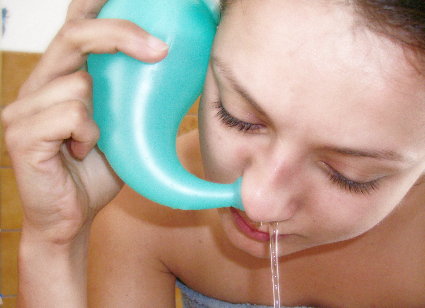
When using a neti pot, the solution goes into one nostril and comes out of the other - Lean over a sink
- Tilt your head to one side so that your forehead and chin are at approximately the same level, this prevents water getting into your mouth
- Your breathing from now on is done through your mouth
- Place the spout into your upper nostril and pour the solution so that it drains through the lower nostril
- Blow your nose (clear your nostrils) and do it again on the other side

If the instructions on your neti pot are not clear, you should check with a pharmacist or health care professional, the FDA added.
Only use the following types of water for nasal rinses
- Sterile or distilled water. When you buy them, check the label says "sterile" or "distilled"
- Boiled tap water. It must be boiled for three to five minutes, and then allowed to cool down. If you store it in a clean, closed container, it will be good for use for no more than 24 hours.
- Water that has gone through a filter with an absolute pore size of 1 micron maximum.
Is it OK to carry out nasal rinsing on children?
According to Osborne, after the age of two, if the doctor recommends it, children with nasal allergies may benefit from using nasal-rinsing devices. However, this should only be done if the doctor says so.Written by Christian Nordqvist
Copyright: Medical News Today
Not to be reproduced without permission of Medical News Today
Source: FDA
MLA
n.p. "Improper Rinsing Of Sinuses With Neti Pots Can Be Dangerous, FDA Says." Medical News Today. MediLexicon, Intl., 27 Aug. 2012. Web.
31 Aug. 2012. <http://www.medicalnewstoday.com/articles/249460.php>
APA
http://www.medicalnewstoday.com/articles/249460.php.
Please note: If no author information is provided, the source is cited instead.
Visitor Opinions (latest shown first)
Cleaning the Neti Pot or Nasal Rinse container
posted by Brenda Kelley on 29 Aug 2012 at 1:09 pmThis article does not address the cleaning and storage of the Neti Pot or other equipment used in the nasal flush process. What procedure and storage method is best to prevent bacteria or other organisms from collecting in the equipment?
Neti pot usage
posted by chandra sekhar on 26 Aug 2012 at 7:08 amYogic practitioners in India use ordinary tap water in copper pot .Since copper is antibacterial it doesn't allow microorganisms to grow.There is also elaborate cleaning procedure.
Add Your Opinion On This Article
'Improper Rinsing Of Sinuses With Neti Pots Can Be Dangerous, FDA Says'Please note that we publish your name, but we do not publish your email address. It is only used to let you know when your message is published. We do not use it for any other purpose. Please see our privacy policy for more information.
If you write about specific medications or operations, please do not name health care professionals by name.
All opinions are moderated before being included (to stop spam)
Contact Our News Editors
For any corrections of factual information, or to contact the editors please use our feedback form.
Please send any medical news or health news press releases to:
Note: Any medical information published on this website is not intended as a substitute for informed medical advice and you should not take any action before consulting with a health care professional. For more information, please read our terms and conditions.

Source: http://www.medicalnewstoday.com/articles/249460.php
Full Report Read Full Article Read Full Report Get the facts

No comments:
Post a Comment